
What Madonna Gave Us Permission to Become
Aug 16, 2026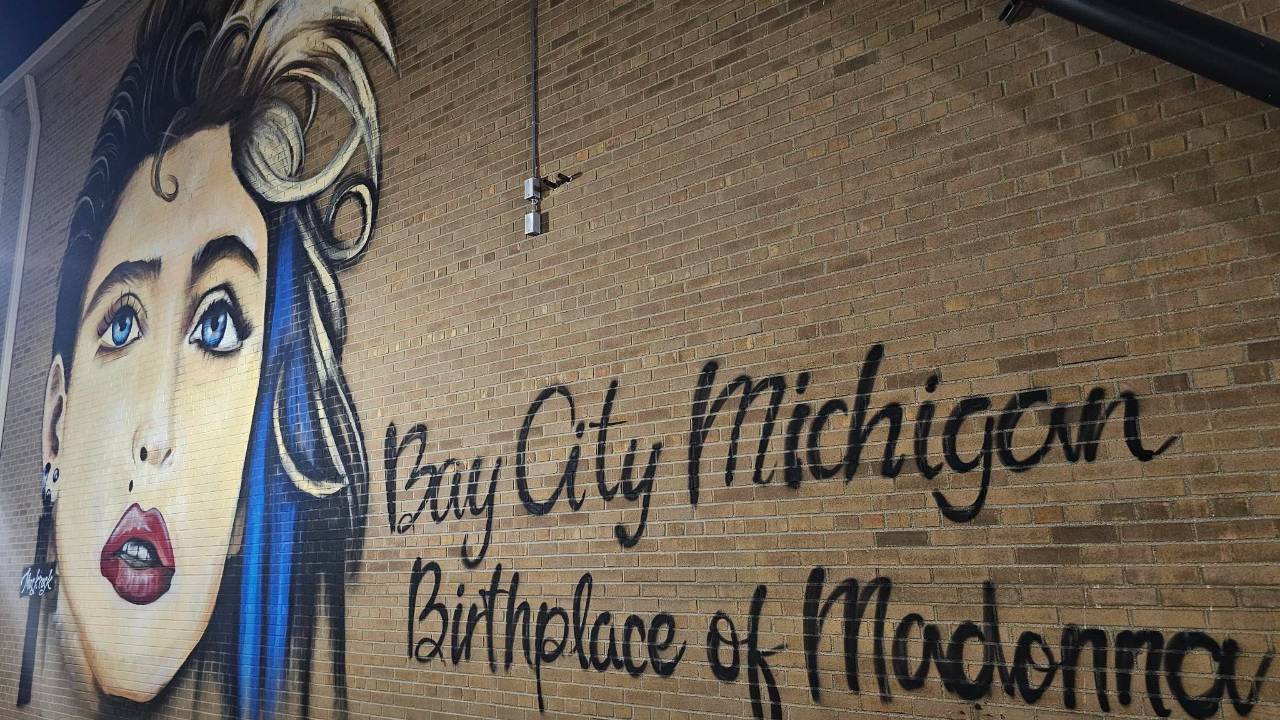
On her 68th birthday, from the Michigan city where she began.
Today is Madonna’s 68th birthday, and I am in Bay City, Michigan, where she was born.
That feels like more than trivia.
My mother’s Polish side of the family is from Bay City, so us Wirgowski’s have always claimed Madonna as our girl. Bay City itself has sometimes been a little more complicated about claiming her. Madonna once called it a “smelly little town,” a remark that became such a part of local lore that it inspired an entire documentary short. Honestly, I know what she meant. Bay City has sugar beet factories, refineries, industry, and the changing smells of a working Michigan town. I never thought of those smells as bad. They were simply part of the place. And something that, as a kid, I knew when we were ‘here,’ when the car passed those smells, when we arrived at midnight to my Grandparents' magical house. So nostagia sense memory.
And this place means something to me.
It means standing in the city where a girl named Madonna Louise Ciccone entered the world and thinking about everything she became after she left it.
I have loved Madonna all my life, and her influence has been a guiding light; her music is medicine, whether healing or celebratory, or when I need a good cry or rallying cry.
I was an MTV kid. I grew up when music videos were not promotional accessories to a song. They were events. They were tiny films, fashion editorials, dance performances, cultural arguments, and portals into other possible lives. I wanted to become a music video director. By the time I was in college, the form already seemed to be waning from its astonishing peak, but Madonna had shown me what it could be.
She understood that a song could become a whole world. Music videos formed my storytelling and production aesthetics.
I can still see the “Express Yourself” video and the live performance with Donna De Lory and Niki Haris, with Madonna in that black bustier, those green pants, and black boots. I remember thinking: Wow. The strength. The theatricality. The women moving together. The permission of it. That was my senior year of high school. That song is in my top five.
Madonna absorbed art, cinema, fashion, religion, dance, sexuality, politics, and history, then put her finger into the current and made something unmistakably her own. If you know her work, you can trace the references and find the Easter eggs. You can see the influence of Tamara de Lempicka, Fritz Lang, Marilyn Monroe, Catholic iconography, ballroom culture, and old Hollywood and, and and.... She never hid the fact that artists influence artists. She invited us to notice, learn, and look again.
My favorite old-school Madonna song is “Holiday.” My favorite Madonna song, full stop, is “Ray of Light.” That song still feels like the sound of becoming. It is motion, illumination, hunger, release.
But I became a true diehard during my years at the University of Washington, from 1990 to 1993.
My gay friends and I went dancing every Thursday night at Re-bar in Seattle. We were theater kids, so of course Madonna made perfect sense to us. She was theatrical, subversive, funny, glamorous, disciplined, and completely committed to the bit, even when the bit was also a profound cultural intervention. She made dance and choreography so iconic every performer has borrowed from her ever since.
“Vogue” arrived during those years. We spent hours in my friend Molly’s wonderful apartment voguing, listening, talking, and living inside Madonna’s world. Then Truth or Dare came out, we devoured it, and quoted it to each other.
It is difficult to explain now how unprecedented that film felt. Madonna did not simply let cameras backstage. She made the machinery of performance, celebrity, friendship, sex, ambition, queer community, control, and vulnerability part of the art. The dancers were not faceless bodies behind a star. They were people. Gay men were visible, affectionate, funny, talented, complicated, and alive at a time when too much of America treated gay lives as disposable or unspeakable. In the early 90s, we were all worried about HIV and AIDS (that was another pandemic that so many did not live through); we lost an entire generation of beautiful humans. Many artists and creatives. And through it…
Madonna kept the fucking door open.
She opened doors for women. She opened doors for the LGBTQIA+ community. She opened doors for artists who wanted to own their image, change their image, own their music and masters, contradict the “rules”, and use pop culture to say something larger than a chorus.
And she paid for it.
She endured the stupid questions, the moral panic, the religious outrage, the misogyny, the accusations, and the endless demand that she explain who she thought she was. Now she receives the particular punishment our culture reserves for women who refuse to disappear as they age.
Men become silver foxes. Men age like fine wine. Madonna puts on thigh-high boots at 67 and people ask what an “old lady” is doing dressed like that. (idiots)
What she is doing is remaining herself. And on that continued quest: who am I, and why am I here?

She has fallen in love. She has had babies. She has changed her hair, her body, her sound, her lovers, her collaborators, her spiritual practices, and her creative language. We have watched all these incarnations unfold within one human life. People call that reinvention, but sometimes I think reinvention is simply what a woman’s life looks like when she refuses to freeze at the age when the world first found her desirable.
Reinvention is not evidence that we were lost.
Sometimes it is evidence that we kept becoming.
We keep becoming. All of us.
Madonna has never asked permission to remain visible. By doing that, she gave the rest of us permission to be visible too. She gave us permission to be sexual, spiritual, ambitious, playful, contradictory, aging, unfinished, and still hungry for whatever comes next.
She did not merely reinvent herself. She expanded what women were allowed to become.
This year, at 67, she released Confessions II, a sequel to Confessions on a Dance Floor. The album debuted at No. 1, making her the first woman to have a No. 1 album in five consecutive decades. Now she turns 68 with another first behind her and, I suspect, more ahead.

Every generation gets its own Madonna. How lucky are we that some of us have lived through five decades of her?
Gen Z and Gen Alpha gets to discover her now, whether through their parents, the original records, or this new Confessions revolution. They get to encounter the woman who has spent a lifetime reaching across language, culture, genre, and identity to create a global dance floor. She is an Italian American white girl born in Michigan who learned how to recognize the charge in another culture, another visual language, another beat, and turn that curiosity into connection.
She has not always done it perfectly. No artist working this boldly, for this long, could. Her humanness is part of what keeps me interested. She tries. She reaches. She falls in love. She makes mistakes. She gets knocked down. She gets back up and makes another thing. Human, analog, digital, and ever morphing.
That creative fierceness has stayed with me.
Her picture has been my phone wallpaper for years. I have a group chat with friends dedicated almost entirely to talking about her (love you two LouLou and Scott). We follow her and get together for her concerts in different cities. When Confessions II came out, I was sharing and so enjoying the community and exuberance of fans on Threads and Instagram, the remixes, the DJs, the being on Zoom calls doing listening parties together across the world. I rented a car and drove across Los Angeles to the Melrose pop-up. I wanted to stand among the other people who loved her. I picked up albums and T-shirts for best friends who lived elsewhere. Being in Los Angeles sometimes means making those little pilgrimages, and this one felt sacred.

I have not met her yet. I hope I will.
But influence does not require proximity. Patron saints do not have to know your name to help you find your way.
Madonna is one of mine.
Today and many times I’ve driven around Bay City thinking about how the goddess started here. I’ve visited the former Mercy Hospital site and stood beneath the sign in a pose, because of course I did. I love the Madonna mural painted by Jules Muck, also known as Muck Rock, a Venice-based artist from the place I now call home in California. There is something almost too perfect about that connection: Venice Beach reaching back to Bay City through another woman artist’s hand.
At the Historical Museum of Bay County, Madonna has her rightful place in the Michigan Rock and Roll Legends Hall of Fame. I also learned about Smelly Little Town, Zach Neumeyer’s documentary about Bay City’s complicated relationship with its most famous native. It makes me laugh because the title contains both the friction and the affection of home. I can’t believe I didn’t know about that; I cannot wait to watch it. “I have great affection for Bay City.” The other quote from her in 1987 on the Today Show adorns her section in the museum.

Madonna grew up closer to Detroit. She attended the University of Michigan for dance before leaving for New York and everything that came afterward. Bay City may not be the place that formed all of her, but it is the place where her life began.
Beginnings matter.
Home is complicated. Sometimes it is the place that nurtures you. Sometimes it is the place you must leave. Sometimes it is the fixed point you spend the rest of your life interpreting. Sometimes you can love a place while knowing it could never hold all of who you needed to become.
Bay City is a fixed place for me, having spent almost every summer here from the time I was born into my high school years, with my family home changing with my Dad’s many promotions and transfers to JCPenney’s department stores that needed ‘fixing’ to become profitable. The Wirgowski yellow kitchen Formica table was a touchstone. Bay City is a place that is ‘home’ that I love to visit.
Tonight my family is having cake. We are celebrating my parents’ 60th wedding anniversary, my aunt and uncle’s 50th anniversary, and my aunt’s birthday. There will already be so much life gathered around that cake.
I am going to add one more candle.
I will light it for Madonna and blow it out for her here in Bay City, the city where her timeline began and where my family’s timeline continues.
What a gift to be alive during hers.
Happy birthday to Our Lady Madonna. Mother. Goddess. Michigan girl. Patron saint of the dance floor and of women who refuse to become smaller.
Thank you for keeping the door kicked open.
You do not owe the world a quieter version of yourself simply because you have lived long enough to make other people uncomfortable.
Keep becoming.
Protect the Queendom.

The Sample
The spark for this essay was being in Bay City, Michigan, on Madonna’s 68th birthday. I have loved visiting the places where the city remembers her, thinking about the ways her music, videos, courage, and creative authorship have accompanied my own life.
Track Notes
This piece is about Madonna as more than a celebrity or pop star. It is about what her life made possible for women, the LGBTQIA+ community, artists, theater kids, dancers, and anyone who needed permission to become more visible.
It is also about the complicated meaning of birthplace. Bay City is part of my family’s story and the beginning of Madonna’s. Standing here today reminded me that where we begin matters, and helps us on the way to what we become.
Liner Notes
Listening to:
-
“Holiday”
-
“Ray of Light”
-
“Vogue”
-
“Express Yourself”
-
Confessions II
-
Um. all of it always. :)
Watching and revisiting:
-
Madonna: Truth or Dare, also known as In Bed With Madonna internationally. The film is a groundbreaking 1991 documentary that offers an intimate look at Madonna during her 1990 Blond Ambition World Tour, blending concert footage with personal insights.
-
“Express Yourself,” especially the dancing and visual world that first made me want to direct music videos. Premiering on MTV on May 17, 1989, the video was heavily inspired by Fritz Lang’s 1927 film Metropolis and became one of the most expensive music videos ever made at the time, with a budget of $5 million - Wikipedia
-
Smelly Little Town, directed by Zach Neumeyer (Interview with Zach) - Filmed in 2019, the short was shot on location in Bay City and features interviews with residents, local historians, and cultural advocates. Local historian Gary Johnson, a longtime promoter of Bay City’s music scene, played a central role in the project - Wikipedia.
Visit:
-
The former Mercy Hospital site in Bay City, 100 15th St.
-
Jules Muck’s Madonna mural, at the City Market, old home of JCPenney’s Department store, anda yummy ice cream store run by long time locals Dan Macia, The Polar Lab located inside the City Market, 401 Center Ave.
-
The Michigan Rock and Roll Legends Hall of Fame exhibit at the Bay County Historical Society
Sources for the current record:
Next Track
What happens when the women who taught us to become refuse to disappear?
Stay connected with news and updates!
Join our mailing list to receive the latest news and updates from our team.
Don't worry, your information will not be shared.
We hate SPAM. We will never sell your information, for any reason.
