
The Return of the Third Space
Feb 16, 2026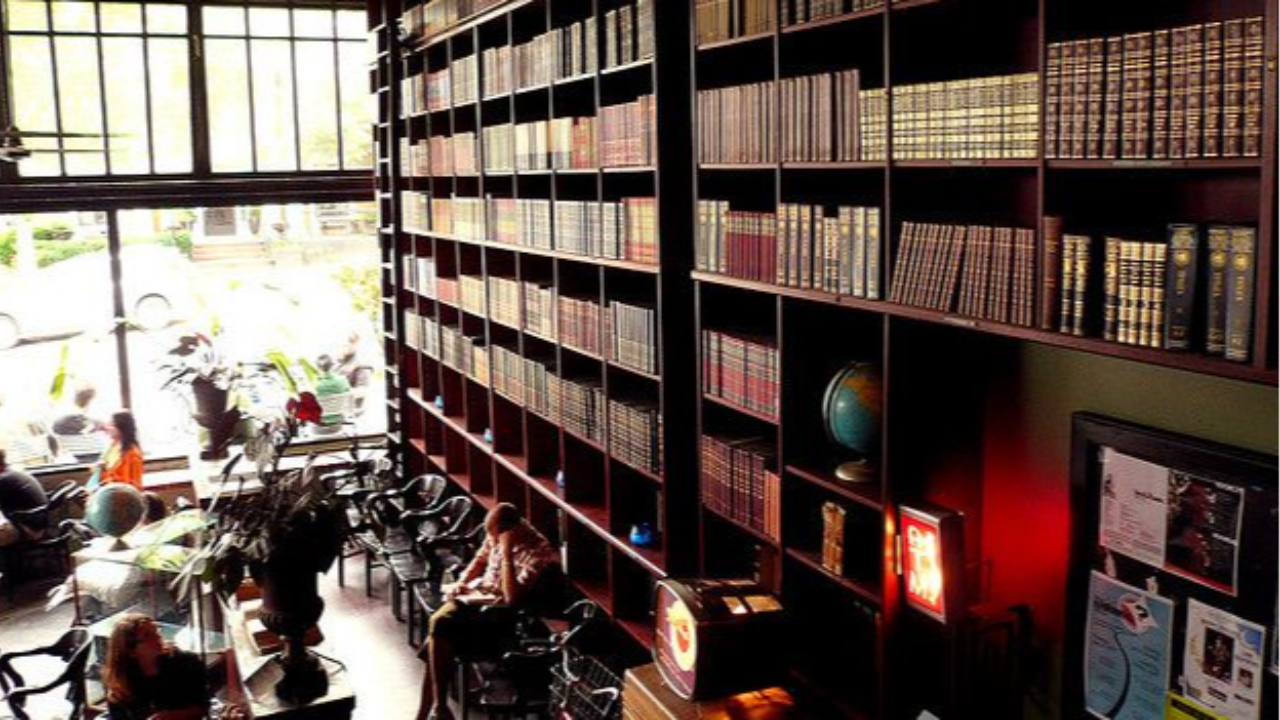
“I want 3rd spaces to return. I’m tired of the only options being bars, restaurants, breweries and semi abandoned malls. We are tired of socially performing. I want a coffee shop that has lovely couches, that’s open late, that has low stimulation activities. Places for ambient low stakes connection.” – damour_art_oracle @ Threads – 1/31/2026
That was the post that stopped and inspired me mid-scroll.
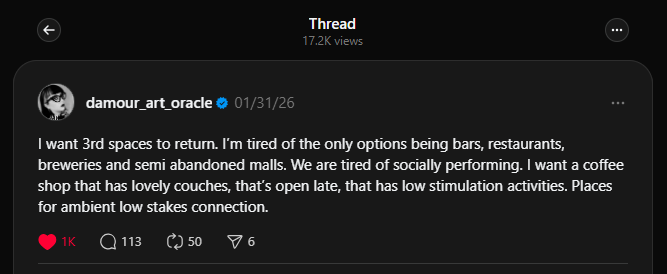
It wasn’t dramatic. It didn’t argue. It didn’t over-explain. It simply named something. And a hundred people responded, not with debate, but with recognition.
There’s a shared longing in that post.
Not quite grief. Not exactly nostalgia. More like a collective remembering and a quiet question: Where did those places go? And can we build them again?
I’ve spent my life in rooms like that, building them, dancing in them, grieving them, and trying to understand why they matter.
I wanted to write this because I felt it too. Not abstractly. Not academically. But in my body.
We don’t just miss places.
We miss permission.
Permission to linger.
Permission to exist in public without optimizing ourselves.
Permission to be around other humans without being “on.”
The disappearance of the third space, the place that isn’t home or work, has left us with a narrow menu. Bars. Restaurants. Breweries. Ticketed events. Coworking spaces. Places that subtly ask you to keep buying something.
For some, that third space has always been church, or temple, mosque, synagogue, spiritual community. A place to gather weekly. To sing together. To share meals. To mark time. To sit in collective silence. Even for those who no longer participate, it’s worth recognizing how many generations learned the rhythms of community in rooms like that. Third spaces have always taken many forms.
And many of us are tired, just looking for a place to be.
The Pause We Never Fully Came Back From
There’s another layer to this longing that’s harder to name.
Covid didn’t just close our third spaces. It rewired our relationship to them.
For a long time, staying home wasn’t a preference. It was survival. We shrank our lives out of necessity. We learned how to be alone. We learned how to make our homes do everything.
When things reopened, something felt different. Prices were higher. Hours shorter. Energy cautious. Even now, there’s a low-level wariness that lingers about illness, about crowds, about proximity. About being disappeared.
What began as fear quietly became habit.
Last Halloween, I went to a house party, the first one in almost four years. A kitchen crowded with mismatched drinks. A DJ in the corner, just a little too loud. Strangers in costume brushing shoulders. Conversations overlapping.
It was wonderful. And it was overwhelming.
I remember thinking, Oh. I remember this. Not just parties, but proximity. The accidental intimacy of being thrown together without a plan.
Even as someone who is extroverted and genuinely loves people, I socialize differently now. I stay home more. I choose quieter spaces. I need more recovery time. That’s not a flaw. It’s a cultural aftereffect.
And yet I still love music. I still love dancing.
What’s changed is how and where I seek it out. Outdoor gatherings. Day parties. Rooms that don’t demand a 2 a.m. endurance test.
There’s a reason DAYBREAKER resonates, a global community and social experiment, more than a decade deep, spanning cities around the world, built around joy and belonging. There’s a reason Early Birds, daytime dance parties for women over 50 who still want to move but also have lives in the morning, feel like exactly the right evolution.
These aren’t compromises. They’re adaptations.
And those dance spaces taught me something else early on. Safety matters.
In Seattle, Re-Bar, now closed, was one of the first places I experienced what it meant to be welcomed as everyone. It was unapologetically LGBTQ-friendly and equally unapologetic about its boundaries. No racist, bigoted, or asshole behavior. It was literally on signs posted on the door.

The best third spaces don’t just invite people in. They protect the room.
As I’ve started DJing more, I feel this shift even more clearly. I love reading a crowd. Feeling the energy rise. Building something together that only exists for that hour in that room. Dancing isn’t an escape. It’s participation. Whether I’m on the floor or behind the decks, I’m in a relationship with the people around me.
There are quieter versions of this, too. My boyfriend goes to a game night that has been running for over twenty years. Board games. Strategy. Regulars who return again and again. Sometimes they open it up on Meetup. Sometimes it’s just the core crew.
I join occasionally. I love watching them. The focus. The counting. The tactile pieces. The long arcs of thought. I fall into that rhythm when I’m there.
That immersive zone, the same one I enter when I’m writing or DJing, is regulating. We all have different rituals that lower our cortisol and remind our nervous systems that we’re okay.
In a world that feels constantly on fire and politically fragile, those small, sustained gatherings aren’t escapism.
They’re resilience.
And in many ways, I’ve been building third spaces professionally for years. As an event producer, I design gatherings where connection happens not just on stage but in hallways, in corners, in transitions. For many tech communities, conferences and recurring meetups function as their third space. They are anchor points. Identity-forming. Relational.
Third spaces don’t have to be quaint to matter.
They just have to be intentional.
It seems to me that we didn’t just lose places. We lost our muscle memory for gathering. Now we’re relearning. and looking for the next chapters or a return to the analog, or maybe it is nostalgia.
The Rooms That Raised Me
Before I had language for any of this, I knew it through theatre.
I was a theatre major, but what I loved most wasn’t the spotlight. It was the room. The rehearsal. The shared act of building something that didn’t need to scale to matter.
My friends and my ex-husband ran a Seattle-based fringe theatre company called GREX, and we rented spaces all over Capitol Hill and the ‘warehouse district’ before Amazon and Google swallowed up all those artist spaces. And I spent countless hours at Theatre Schmeater, Schmee, as we called it. It wasn’t just a venue. It was an ecosystem.
Just down the street was my friend Paula Fletcher’s shop, Dumb Clothing. Between rehearsals, especially when we were staging The Yellow Wallpaper, I’d take my cast there. We’d browse. Laugh. Breathe. And she would effortlessly dress us in her fabulous designs.

My beloved Bauhaus Coffee on Melrose and Pine anchored both my University of Washington years and my fringe theatre years. Paula is no longer with us; we lost her to breast cancer. Bauhaus is gone. Re-Bar is gone. The skyline has shifted.
When I visit Seattle now, one of my homes, I feel those absences. Not just buildings. The way those places held us.
Third spaces don’t just host culture.
They teach us how to be in it.
The Renaissance We’re Quietly Building
Despite everything, something hopeful is happening.
Sober bars like my friend Abby’s Hekate Café & Elixir Lounge are redefining nightlife without alcohol at the center. Hush Harbor asks patrons to put their phones away and be present. Lectures on Tap brings professors into bars for thoughtful talks. Restaurants have become havens, food banks, gathering for mutual aid, clothing swaps, and getting groceries for neighbors.
Libraries evolve. Silent reading nights fill up. Game groups endure. Dance collectives gather in daylight. And neighbors open up their spaces for each other.
These spaces already exist.
They just need us.
A Civic Imagination
I’ve long said I want to be the U.S. Postmaster General.
Not for the title. For the infrastructure.
The post office is one of the last civic institutions that still belongs, at least in theory, to everyone. It moves letters, ballots, care packages, love notes. It produces a massive body of artwork in the form of stamps. It sits quietly in neighborhoods doing its work. Postal workers should be sainted.
Libraries are similar. Radical in their quietness. You can walk in without buying anything. You can sit. You can read. You can think. You can attend a lecture or simply be warm in winter and cool in summer. You can be taken care of by some of the most intelligent, caring, feisty, and activist humans on the planet. I (heart) librarians.
What if we re-imagined these places as shared civic sanctuaries?
A place where you could mail a letter, pick up a book, attend a rehearsal, join a workshop, sit in a community room, and meet a neighbor. Bring food for the food bank, and sign up to volunteer to help where needed.
Where artists are invited to create murals both inside and outside of the building.
Not a mall.
Not a branded experience.
But public space woven intentionally into the life of a neighborhood.
We talk about loneliness as if it’s a personal failing.
But loneliness is often architectural.
If we want belonging, we have to build for it.
And we know how.
We’ve done it before. And these places I mentioned, and in many places around the world, they are the center point of a town or city that you know is there, will be helpful, will harbor you, and help you on your way.
When the world feels unstable, when the threat of authoritarian rule is no longer theoretical, we need our third spaces even more. Not just for comfort, but for courage. For organizing. For joy. For the kind of human proximity that makes fear harder to weaponize.
Democracy isn’t only protected in courtrooms or ballot boxes. It’s strengthened in rooms where people gather, talk, argue, plan, dance, read, and care for one another. Authoritarianism isolates. Community interrupts that isolation.
In that sense, a dance floor, a library table, a game night, a black box theatre, they are not luxuries.
They are rehearsal spaces for freedom. And a harbinger of joy, never, ever forget the joy.
What We May Be Longing For
When people say they want third spaces back, maybe what they’re really saying is:
I want somewhere to go where I don’t have to buy myself in.
I want to feel safe.
I want to feel part of something.
I want to remember that I’m not alone.
This isn’t regression.
It’s survival.
And here’s the part we shouldn’t miss. Third spaces are not entirely gone.
They are already here.
They are the café that has survived three rent hikes because the owner knows everyone by name.
They are the library hosting a reading group on a Tuesday night.
They are the couple that is rebuilding after the natural disaster.
They are the dance party that ends before midnight.
They are the sober lounge pouring mocktails with intention.
They are the game night that has met every month for twenty years.
They are the church basement supper, the black box theatre rehearsal, the neighborhood bar with a sign on the door that makes its values clear.
They are the restaurant that has given out free food every day for weeks.
Community is built in these rooms every day.
Not perfectly. Not at scale. Not always profitably.
But faithfully.
People will continue to invent the third place. They always have. Sometimes it looks like a decades-old neighborhood business holding steady. Sometimes it looks like a twist on an old model. Sometimes it looks like someone opening their doors and saying, "Come in," fulfilling a lifelong dream of brick-and-mortar ownership.
The return of the third space will not be a single grand reopening.
It will be a thousand small rooms, choosing to stay open.
So maybe the work now is not only imagining what we’ve lost.
Maybe it’s showing up for what still exists.
Frequenting it. Funding it. Protecting it. Thanking it.
Because these spaces are not luxuries.
They are rehearsal rooms for belonging.
They are the infrastructure for democracy.
They are proof that we still know how to gather.
And that is more powerful than it looks.
Thank you to all of those who are ‘of service’ and create the third spaces for your communities. You are builders of belonging.
Thank you for reading. I believe that:
Empathy makes us human; actions make us warriors.
I post about business stuff in a newsletter on Linkedin twice a month, sign up here for that one: Maven Musings.
Follow all of my social media work, travels, and writing at my Linktree: https://linktr.ee/heddamaven
Originally posted on Heddas Mix Tape on 2/16/2026.
Stay connected with news and updates!
Join our mailing list to receive the latest news and updates from our team.
Don't worry, your information will not be shared.
We hate SPAM. We will never sell your information, for any reason.
