
My Word of the Year: Sovereignty
Feb 15, 2026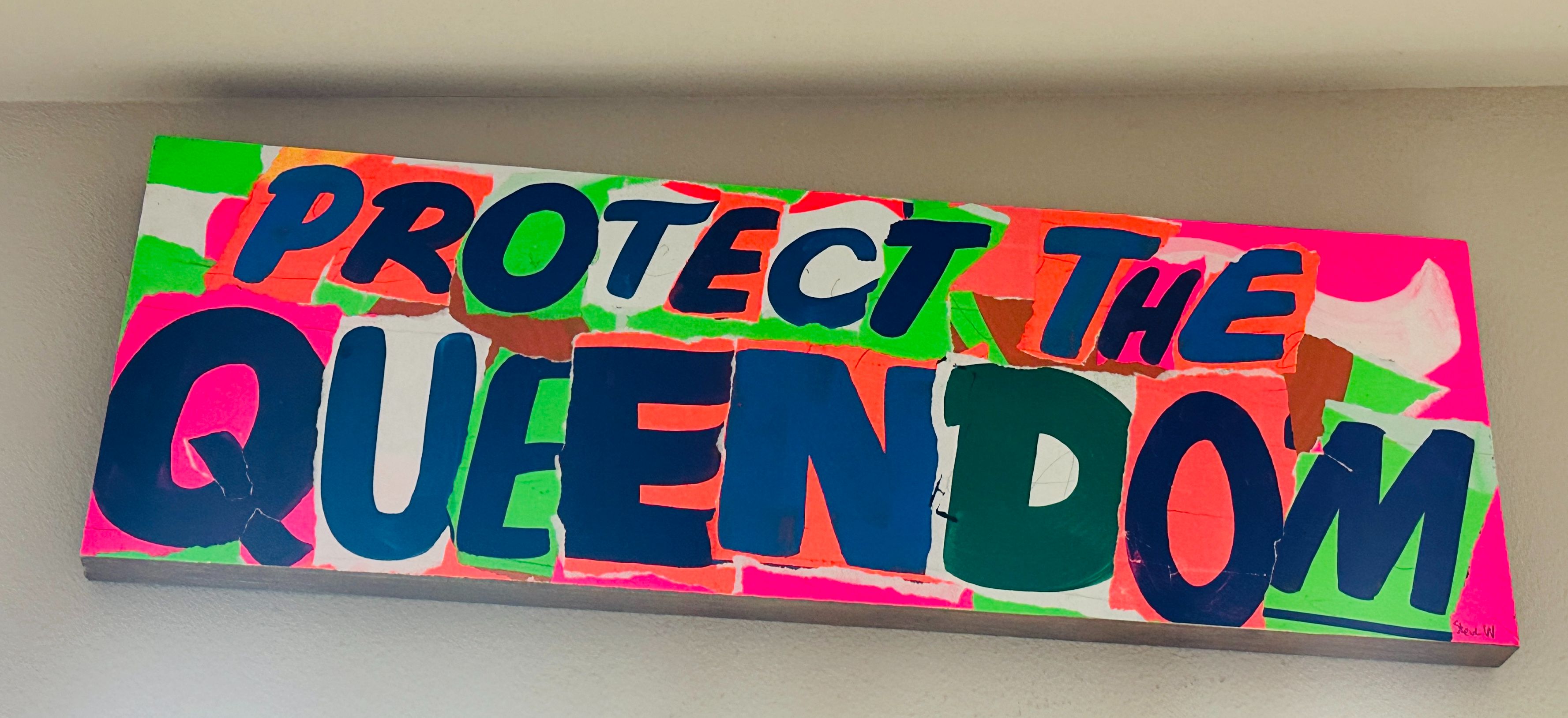
(Or Why My Feral Gen X Self Is Done Asking)
My Word of the Year: Sovereignty
This year, it took a while to choose.
And not the buzzword version.
Not the “manifest it while optimizing your morning routine” version.
The real one. The earned one. Nobody is coming to save you, and that’s actually the point version.
Sovereignty, for me, is inseparable from becoming.
Because becoming always follows collapse. Becoming also simply precludes what is next in the chapters of our book of life.
Last year, my word was Consistency.
And I met it, especially in my writing and posting, a practice I deeply love. Writing is Zen to me. It’s where I metabolize the world, where signal emerges from noise. The year before that, my word was Enough, and learning that changed how I measured everything that came after, and what I needed to let go of.
Sovereignty doesn’t arrive fully formed.
It’s built. First, by believing you are enough. Then by showing up consistently for what matters. And finally, by trusting yourself to stand in your own authority.
We are living through a death knell. An extinction burst.
The last, loud thrashing of the patriarchy as it realizes, too late, that it no longer owns the narrative, the labor, the bodies, or the future.
What we’re witnessing isn’t chaos.
Its systems are losing legitimacy.
And sovereignty is what you reach for when we quiet the old gods’ answers. And when the goddesses stretch out their hands to lead.
Sovereignty isn’t about control.
It’s about return.
It’s the moment you stop outsourcing your authority to algorithms, institutions, relationships, trends, or the version of yourself you built to survive other people’s expectations, and quietly or loudly, and definitely stubbornly, take it back. Maybe she’s born with it, maybe its…. matriarchy.
No announcement.
No permission slip.
Just a recalibration so deep it changes how you move.
Centering Yourself Is Not Selfish. It’s Structural.
Women are trained, explicitly and implicitly, to orbit.
Other people’s needs.
Other people’s comfort.
Other people’s timelines.
Patriarchy depends on women never fully occupying their own center.
It collapses the moment we do.
Centering oneself isn’t about narcissism. It’s about ending the habit of disappearance.
When I say I’m centering myself, what I mean is:
-
I’m no longer confusing endurance with virtue
-
I’m no longer shrinking to keep systems intact
-
I’m no longer negotiating my own knowing
This is sovereignty in practice.
It’s choosing internal alignment over external applause.
And yes, this makes people uncomfortable.
Good. Discomfort is the sound of a structure cracking.
Enter: The Feral Gen X Woman
My friends and I grew up on Star Wars.
On rebellion as a moral imperative.
On scrappy collectives taking on bloated empires.
On the understanding that power hoards, lies, and eventually implodes.
We were always going to be the rebellion.
Gen X women watched institutions rot in real time.
We were raised on latchkeys and skepticism.
We learned early that authority figures were often underqualified, overconfident, and wildly unaccountable.
We were the first generation of young women who truly had the ability to open a bank account, take out a bank loan, get a credit card, go to college, govern our bodies, be what we wanted, and choose to get a divorce. This reversal of rights, which we are in the middle of, is written by a foundation, planned for three decades, infested into our communication systems, put out as a manifesto, and being implemented by a regime, and it is maddening.
So when a Gen X woman goes feral, it’s not rebellion.
It’s recognition.
Feral doesn’t mean reckless.
It means:
-
immune to bullshit
-
allergic to hierarchy cosplay
-
uninterested in being optimized
-
deeply protective of time, energy, and truth
The feral Gen X woman doesn’t want your funnel.
She wants her life back.
She’s not trying to burn it all down. (ahem..)
She’s trying to stop pretending the Empire was ever legitimate.
And she is sitting herself in places, at tables, in positions, in movements, in book clubs, in mutual aid groups, and in moments that matter.
Princess Leia Is My Goddess
Leia didn’t wait to be rescued.
She led while grieving.
She strategized while resisting.
She loved without surrendering her authority.
She was softness and steel.
Grief and command.
A general in a gown, a diplomat with a blaster.
If sovereignty has a face, it looks like a woman who knows who she is inside the fire.
That mythology mattered. It shaped us.
We learned that rebellion wasn’t loud posturing. It was loyalty, clarity, and refusal.
That leadership didn’t require permission.
That the future belonged to those willing to imagine it after a collapse.
And then Andor made the mirror unavoidable.
It was hard to watch, not because it was bleak, but because it was accurate. The slow creep of authoritarianism. The paperwork. The surveillance. The way oppression doesn’t arrive as spectacle, but as process. And yet, it was also deeply inspiring. A reminder that rebellion is built by ordinary people choosing integrity over safety, again and again, long before history decides to notice. The people of Minnesota come to mind here.
That’s sovereignty, too. Not the fantasy of heroism, but the quiet, costly refusal to disappear inside systems designed to exhaust you.
Sovereignty (for women) Is Incredibly Inconvenient
Sovereignty doesn’t sell well.
It doesn’t scale neatly.
Because once you stop asking to be chosen, a lot of systems lose their grip on you.
Especially systems built on your compliance.
Sovereignty looks like:
-
saying no without explanation
-
walking away before you’re burned out
-
choosing rest over righteousness
-
trusting your timing instead of chasing relevance
-
deciding for yourself where your presence creates the most good, even when the choice isn’t simple
It’s not performative.
It’s not pretty.
It’s not for the algorithm.
It’s for what comes next.
Becoming After the Fall
Extinction bursts are violent because they are desperate.
They are the final attempt to reassert control, even as authority is already slipping. The grip on your ankle that tries to pull you down with them.
You can see it in real time.
When legislation like the SAVE Act resurfaces, something I wrote about last April, it is framed as “election integrity,” but functions as voter suppression. It makes it harder for women to vote, particularly those who have changed their names. It is a poll tax.
This isn’t theoretical. It’s bureaucracy weaponized to quietly claw back rights that were never freely given.
I remember what I felt when Roe fell. The shock. The grief. The recalibration.
Part of me wants to believe we are at a tipping point, that the steady chipping away at our autonomy cannot continue indefinitely.
But the continued anger rising isn’t outrage culture.
It’s pattern recognition.
Naming sovereignty requires acknowledging the privilege it rests on, and the women before us who fought, suffered, and died to make it imaginable.
As a white woman, part of my responsibility is to listen to Black women and all women of color, who have been naming these realities long before it was safe or socially rewarded. They have lived the conditions that many are only now recognizing. Their clarity has never depended on a crisis to be legitimate.
Sovereignty doesn’t mean speaking first.
It means knowing who to follow.
I am not naming anything new. Black women have been writing and organizing around these conditions for generations. This lineage lives in the work of Audre Lorde, bell hooks, the Combahee River Collective, Kimberlé Crenshaw’s articulation of intersectionality, and contemporary writers like Brittney Cooper and Mikki Kendall. (A list of some of their works is at the end of the article.)
It is longstanding scholarship and lived experience that many are only now choosing to hear.
But listening is not agreement in theory.
It is alignment in practice.
And that is where the question shifts.
I keep returning to a quieter question I see surfacing, about decentering men, and also re-centering community:
Who is in your circle of service?
Who do you prioritize, protect, and materially resource, not rhetorically, but tangibly?
Where do you shop?
Whose businesses do you sustain?
Who builds your community?
Where we put our dollars is policy.
Black-owned.
Indigenous-owned.
Latine- and Asian-owned.
Queer- and trans-owned.
Women-owned.
Worker-owned.
Community-centered.
This isn’t about shutting anyone out.
It’s about shifting capital toward those who have built despite systemic exclusion. And where we put our dollars, and our devotion, is part of sovereignty.
What follows an extinction burst is not emptiness.
It is recomposition.
Becoming is what happens when women stop bracing for impact and start building from the rubble.
When we choose sovereignty not as a reaction, but as a foundation.
And if you are a man in my life, all of our lives, we need your allyship.
Not in theory. In action.
Alongside us. Speaking out. Supporting.
Rebellion, Reclaiming, Reinvention, Re-re-re-re SPECT
The rebellion doesn’t need your martyrdom. It needs your wholeness.
And let me be clear about this. Rebellion is not only resistance. It is joy. It is dancing. It is love, unity, and taking absolutely no shit. It is choosing aliveness in the face of systems that depend on your exhaustion. Celebration is not a distraction from the fight. It is how we survive it. It is how we remember what we are fighting for. Disco House music will be this decade’s fist-in-the-air soundtrack.
You don’t need to be legible to be sovereign.
You don’t need consensus.
You don’t need to explain why your center matters now.
If you’re feeling feral, it’s probably because you’ve outgrown the cage.
If you’re craving sovereignty, it’s because you can feel the future pulling at you.
And here’s the other truth I’m living inside. I am doing my job. I am trying to plan fun things. I am taking this time to write. And I am also crying. I am emotional, full of rage, and exhausted by watching the same ‘isms’ reassert themselves over and over, as if history has not already made their consequences painfully clear.
I want all of this assanine behavior flushed down the toilet. The dissonance is not a failure of clarity. The reality is that many things can be true at once in this moment, just as they have been in many moments across history. Joy and grief. Work and resistance. Love and fury. Sovereignty asks us to hold that complexity without collapsing into numbness or false simplicity.
Before we close, indulge me for a moment. I invite you to go outside tonight and look up at the stars. Allow a little mysticism in if, like me, you are a skeptic believer in most things.
We are at the end of a nine-year cycle, according to numerologists. We are about to step into the Chinese New Year of the Fire Horse. There are planetary alignments shifting, too. You don’t have to believe any of it literally to feel what it points to. Endings. Thresholds. A collective inhale before something new asks to be born.
This is the moment where personal sovereignty and collective responsibility meet. How you tend your own center shapes how you show up for your neighbors, your community, and the fragile experiment of being in this country together.

I think about a night from fifteen years ago on the Lower East Side in New York City. A group of friends. Laughter. That loose joy that comes from feeling alive and unafraid. A fabulous drag queen came up to me, pointed right at my face, and said, “Girl, you need to protect your queendom.”
At the time, I laughed. I nodded. We hugged, and we walked onto the next thing.
There are moments I wish I had listened harder. Not just to her, but to the many voices like hers I passed along the way. And still, I believe this: any moment is a good one to begin again.
I’ve been writing and rewriting this for a month now, and the word sovereignty keeps finding me — in essays, in conversations, in the quiet authority of women who have long practiced it without announcement. One post in particular, which I saw today from my friend Mary Jane Gibson, one of my dearest friends, an extraordinary writer, and a sovereign woman who has been my stalwart sister for decades, and her writing reminded me to post this piece.
Sovereignty is not a destination.
It is a returning.
A practice chosen again and again in small, ordinary moments.
To whom do you listen?
In what you protect.
In how you show up for yourself and for others.
There is no perfect time to claim it.
There is only this moment.
Protect your queendom.
Stand in your own authority.
Believe Women.
Move through the world knowing that your sovereignty, and that of your neighbors, is braided into something older than you and wider than any one of us. A living inheritance. A future being built in real time.
If you want to connect to the roots beneath these thoughts, the ground they rise from, here are some of the women who named these truths long before the world was ready to listen and who are writing today.
Books on Black feminist thought, power, and collective liberation
Stacey Abrams. Lead from the Outside: How to Build Your Future and Make Real Change.
The Combahee River Collective. How We Get Free: Black Feminism and the Combahee River Collective. Edited by Keeanga-Yamahtta Taylor.
Brittney C. Cooper. Eloquent Rage: A Black Feminist Discovers Her Superpower.
Kimberlé Crenshaw. On Intersectionality: Essential Writings.
bell hooks. Ain’t I a Woman: Black Women and Feminism.
bell hooks. Feminism Is for Everybody: Passionate Politics.
Mikki Kendall. Hood Feminism: Notes from the Women That a Movement Forgot.
Audre Lorde. Sister Outsider: Essays and Speeches.
Stay connected with news and updates!
Join our mailing list to receive the latest news and updates from our team.
Don't worry, your information will not be shared.
We hate SPAM. We will never sell your information, for any reason.
