
Humans in the Loop. Humans in the Room. - Newsletter #60
Aug 06, 2026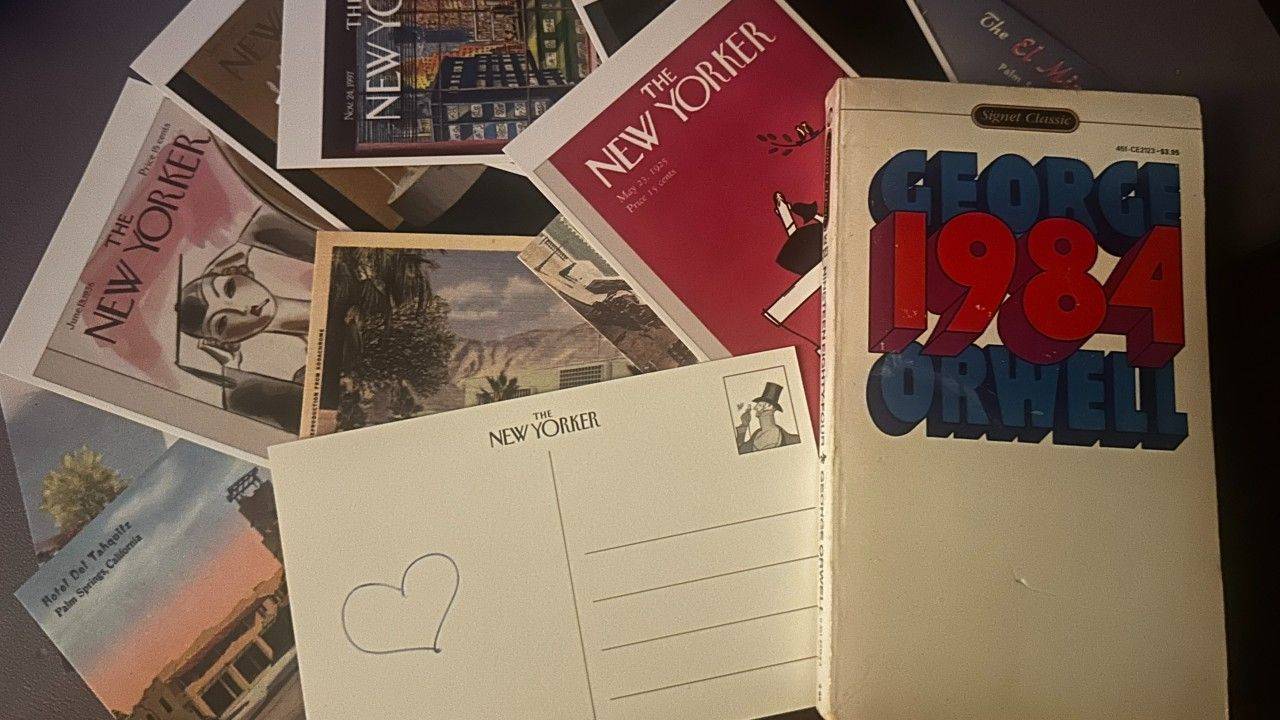
I brought my high school copy of George Orwell’s 1984 to an artificial intelligence presentation.
That may sound like a counterargument before I had even begun.
It wasn’t.
I brought the book because I do not believe we have to choose between AI and analog life. I believe we need both.
This particular copy of 1984 has traveled with me through several versions of myself. I first read it in a post-World War II English class taught by Robert Ledbetter. Around that same time, I was a speech-team geek writing a seven-minute original oratory about why censorship and book banning are un-American.
Later, as a theater student at the University of Washington, I used another copy during a performance piece about the destruction of books. I removed the dust jacket, placed the book over a wastebasket filled with sand, and lit it on fire in a campus theater.
This was dangerous, dramatic, and perhaps exactly what you would expect from a twenty-something theater major.
But I wanted people to feel something.
A physical book has weight. It has texture and history. It holds the memory of who we were when we first encountered its words.
Books do that.
So do records, CDs, ticket stubs, handwritten letters, postcards, theaters, libraries, and the rooms where people have gathered for generations.
These objects and places carry a human record that cannot be reduced to information alone.
Analog Is Not the Opposite of AI
I work at Microsoft. I have been working in and around the company and its communities for twenty-five years, beginning when I wrote some of the earliest customer stories for the product that became SharePoint.
Today, I spend a significant part of my working life using artificial intelligence.
I use Copilot to research, find information, analyze data, develop keynote narratives, draft scripts, create newsletters, summarize meetings, generate graphics, and turn sprawling spoken ideas into organized strategies.
And I still go out of my way to visit libraries.
On the morning of my presentation in New York, I stopped at the New York Public Library. I walked into that magnificent building and inhaled.
Libraries smell delicious.
It is partly the books, of course. But it is also the knowledge. The memory. The accumulated human record surrounding you.
Nothing about my enthusiasm for AI diminishes my love for that experience.
AI and analog life do not have to fight for the same territory. They can exist in parallel, each helping us preserve and strengthen something essential.
AI may help us write better public policy faster. It may accelerate scientific discovery, expand access to education and expertise, help cure diseases, and give us new ways to confront problems that once seemed impossibly large.
But while we build these extraordinary systems, we must continue filling our lives with poetry, music, conversation, art, books, and lived experience.
We need artificial intelligence.
We also need human imagination.
Humans in the Loop
“Human in the loop” has become an important phrase in conversations about responsible AI.
It means that even when technology can analyze, recommend, generate, or act, human beings must remain involved. We bring context, judgment, accountability, empathy, ethics, and the ability to recognize when something simply does not feel right.
I see this in my own work.
My team recently evaluated hundreds of nominations for leadership positions in a global community program. One of my colleagues performed the detailed analysis manually, building tables and carefully examining the results.
Later, I gave the same information to Copilot Cowork and asked it a series of questions.
Within minutes, it surfaced patterns and produced analyses that had taken considerably longer to assemble manually.
That did not mean the human work had been unnecessary.
The comparison showed us something valuable. AI could accelerate the analysis. My colleague brought nuance, history, and an understanding of the people behind the entries.
We still had to discuss the results. We still had to make decisions. We still had to care about the humans represented by the rows in that spreadsheet.
The tool made the work faster.
It did not make our judgment optional.
Humans in the Room
If AI needs humans in the loop, analog life needs humans in the room.
That means conferences and classrooms. Libraries and living rooms. Community meetings, dinner parties, concerts, rehearsals, and theaters.
For me, live theater may be the most beautiful example.
A performance happens once, in one place, among a particular group of people. Even when the actors deliver the same script the following night, it will never be exactly the same.
The audience changes it. The energy changes it. A pause lasts a fraction longer. A laugh arrives where no one expected it. Everyone in the room participates in something that cannot be perfectly reproduced.
That impermanence is part of its value.
We need those experiences because human connection is not a distraction from the work of the future.
It is the reason for the work.
The Tangible Human Record
As our tools become more powerful, our responsibilities grow with them.
We need to build responsible AI.
We need sustainable infrastructure and data centers.
We need security, governance, transparency, and meaningful human oversight.
We also need to protect the tangible human record: our books, letters, art, music, stages, photographs, physical archives, and gathering places.
The future should not require us to discard the objects and rituals that helped us understand the past.
A handwritten letter does something an email does not.
A postcard does something a notification does not.
A library does something a search box does not.
That does not mean one is morally superior to the other. It means they give us different experiences, and we are richer when we retain access to both.
A Message From Yourself
During my presentation, I passed postcards around the room.
I invited each person to write a message to their future self, address it, and leave it with me. I promised to mail the cards sometime before the end of the year.
It was an intentionally analog activity inside a presentation about AI.
A message would travel from one version of a person to another, carried through the physical world by the United States Postal Service.
No instant delivery.
No read receipt.
No algorithm deciding when it should appear.
Just a message, some time, distance, paper, ink, and perhaps a little surprise.
One attendee handed me ten dollars to help pay for the postage because, they said, they believed in community.
That moment mattered to me.
I sometimes joke that one of my remaining ambitions is to become Postmaster General of the United States. Until that appointment arrives, I am happy to serve as the self-appointed Postmaster General of Joy.
But underneath the joke is something I believe deeply.
Technology can help us create remarkable things.
It can help us find one another, organize, solve problems, and turn ideas into action.
And then sometimes, after all that technology has done, we should pick up a pen.
Both Are Part of Our Future
I do not want a future in which we reject AI because we are afraid of change.
I also do not want one in which we become so enchanted by what our systems can produce that we neglect the people, places, objects, and experiences that give our lives meaning.
I want both.
I want AI that helps us tackle consequential problems and gives people more access to knowledge, creativity, and opportunity.
I want books with notes in their margins.
I want beautifully governed SharePoint sites and beautifully chaotic bookshelves.
I want agents that handle repetitive work and friends who stay on the phone when life becomes difficult.
I want digital intelligence and live theater.
I want humans in the loop.
And I want humans in the room.
The future is not AI versus analog.
The future is what we choose to preserve, what we choose to build, and how deliberately we bring our humanity with us.
Empathy makes us human; actions make us warriors.
Stay connected with news and updates!
Join our mailing list to receive the latest news and updates from our team.
Don't worry, your information will not be shared.
We hate SPAM. We will never sell your information, for any reason.
